
A Journey in Thoughtful Christianity
Your Journey with God site is committed to your spiritual growth and personal reflection. We offer books containing devotional inspiration, guided reflections, and practical resources designed to deepen your faith, nurture your soul, and open the door to God’s wisdom for your life.
Whether you are beginning your faith journey or seeking renewed meaning and deeper understanding, we seek to provide thoughtful guidance and encouragement for the way.
Our approach blends thoughtful biblical theology with everyday spirituality—accessible, welcoming, and oriented toward serious spiritual growth. Find inspiration, deepen your relationship with God, and cultivate a life of purpose, meaning, and peace.

The Mystery of God’s Good Providence
The Intervention of his Unfailing Love
The Paradox of his Undeserved Grace
The Depth of His Unfathomable Wisdom
The door to your Journey is open . . .
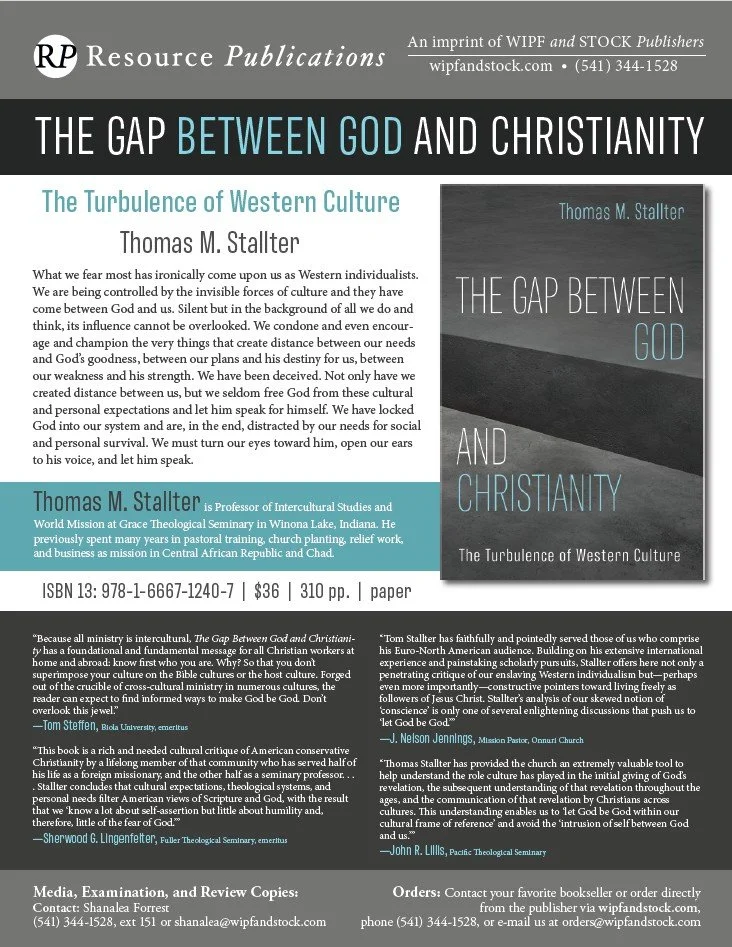
The Gap Between God and Christianity: The Turbulence of Western Culture
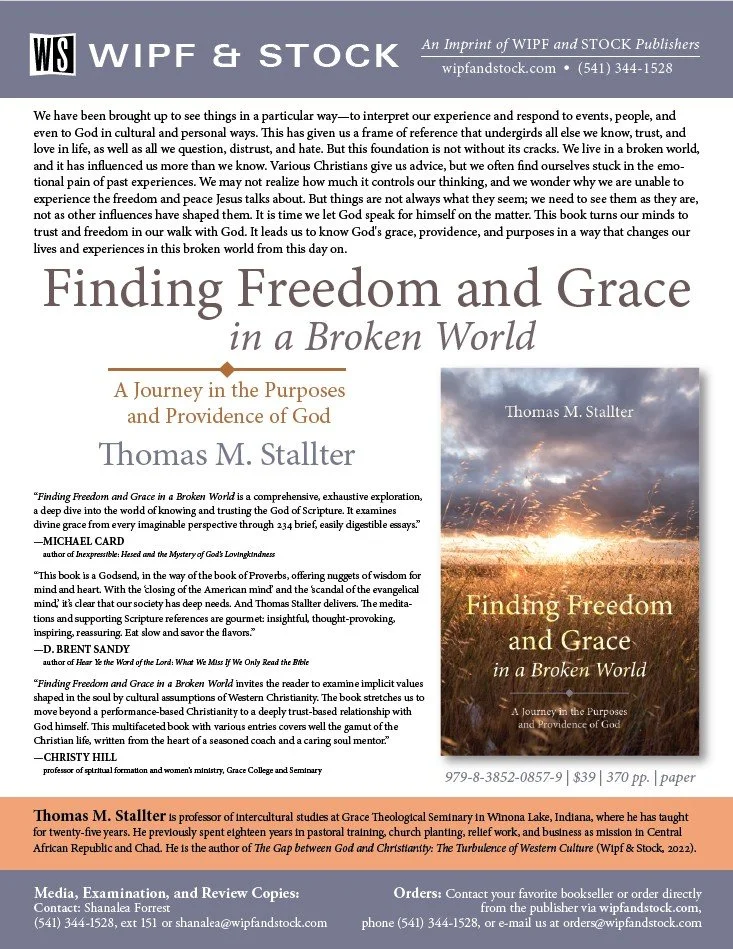
Finding Freedom and Grace in a Broken World: A Journey in the Purposes of God
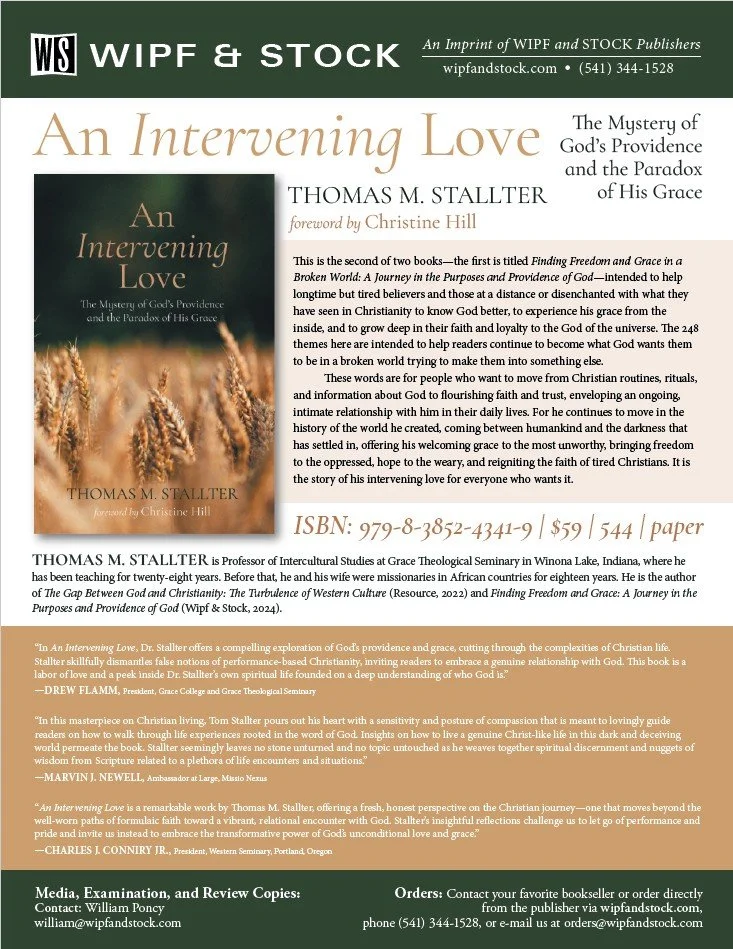
An Intervening Love: The Mystery of God’s Providence and the Paradox of His Grace
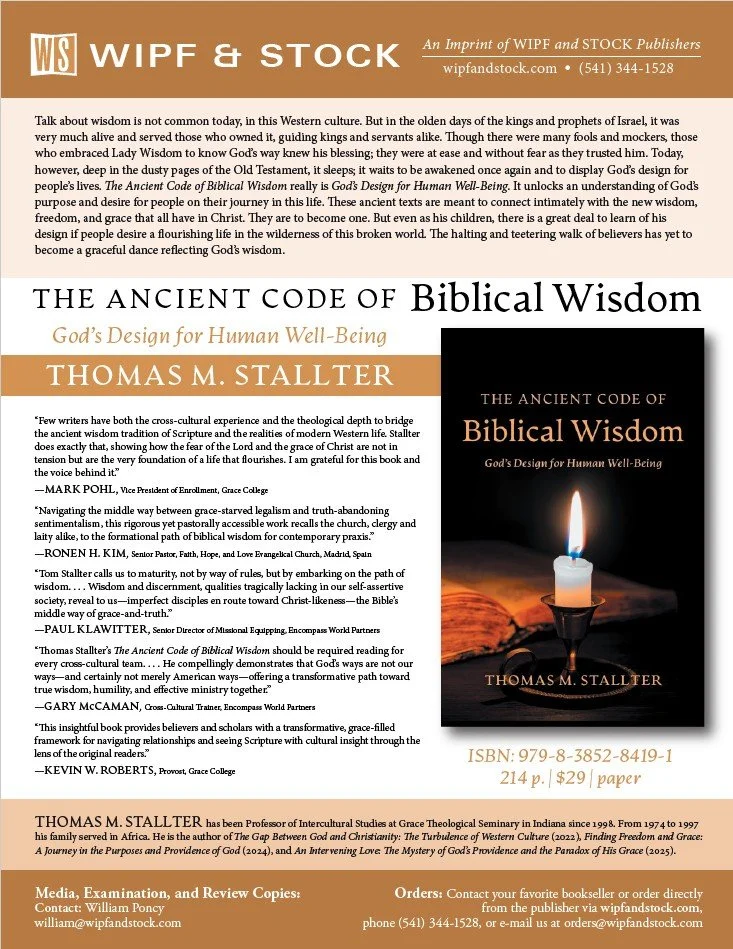
The Ancient Code of Biblical Wisdom: God’s Design for Human Well-being
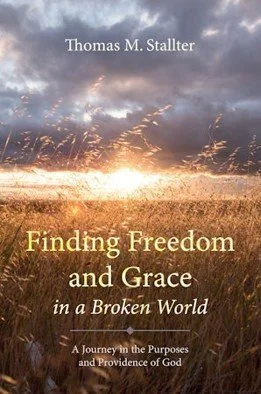
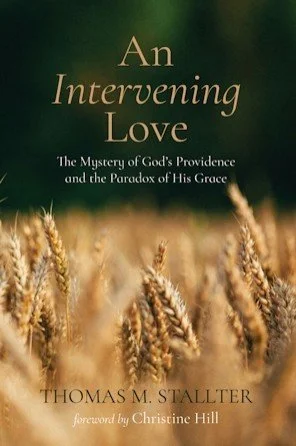
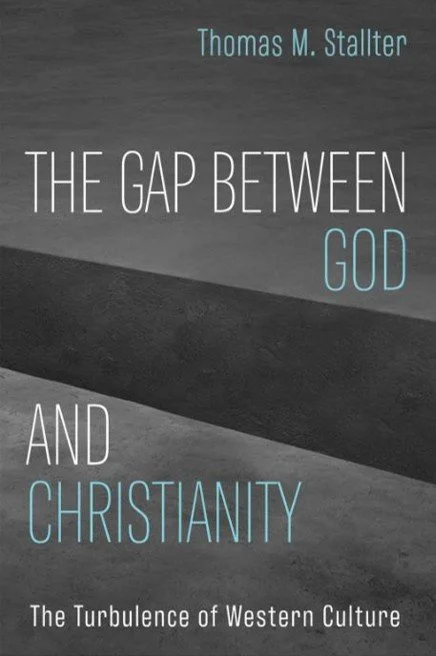
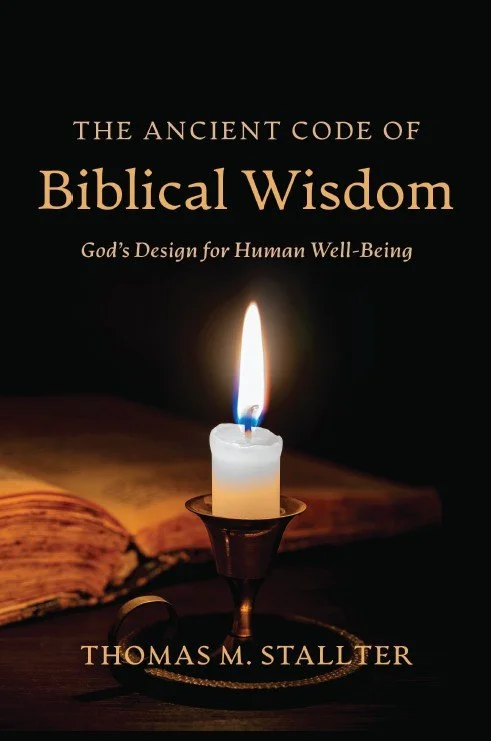
From Cultural Noise to Biblical Wisdom
Thomas M. Stallter’s documents present a connected exploration of how Christians can move from culturally shaped, performance-driven faith toward trust, grace, relational maturity, and wisdom.
Diagnose the gap: Western individualism, achievement, personal preference, and theological systems can filter how people read Scripture and understand God. The Gap Between God and Christianity
Recover grace: God’s forgiveness, providence, and love are presented as gifts—not rewards earned through legalism, ritual, or self-improvement. Finding Freedom and Grace in a Broken World
Practice trust: Anxiety, suffering, uncertainty, and unanswered prayer become opportunities to rely on God without controlling outcomes. An Intervening Love
Live wisely: Biblical wisdom joins truth with humility, discernment, character, justice, kindness, and practical action. The Ancient Code of Biblical Wisdom
Together, the books provide a framework for examining assumptions, deepening faith, and applying Scripture more faithfully in personal, church, and cross-cultural settings.
As such, the collection traces a consistent Christian journey from cultural confusion and self-reliance toward trust, grace, wisdom, and faithful action.
Central message: Flourishing does not come from achievement, control, ritual, or recognition, but from a relationship with God grounded in grace and truth.
Recurring challenge: Western individualism, anxiety, legalism, sentimental Christianity, and cultural syncretism can obscure biblical priorities.
Transforming response: Receive grace humbly, trust God’s providence amid uncertainty, renew the mind through Scripture, and express faith through love and good works.
Practical emphasis: The books are designed for slow reading, topical exploration, Scripture study, journaling, and discussion with others.
Together, these documents can be turned into a focused study plan for spiritual growth for individuals and small groups alike. The sequence moves from diagnosis to transformation: identifying cultural distortion, learning to trust God, experiencing intervening love, and embodying wisdom in daily life.

Each book is a link
to its excerpts...
Thomas M. Stallter is professor of intercultural studies at Grace Theological Seminary in Winona Lake, Indiana, where he has taught since 1997. From 1974 to 1997 he worked in pastoral training, church planting, relief work, and "business as mission" in the Central African Republic and Chad.
“God has given me the opportunity in these, my autumn years of semi-retirement, to seek to encourage other Christians through writing. As one who is here by his amazing grace, I know how badly we all need it.”

-
According to Paul in his letters to the churches, though there is diversity in the body of Christ, the church should be a body of grace-covered, like-minded people who seek to worship God, learn from his word, and encourage each other in every way. Jesus emphasizes the love believers must have for one another and the unity that must characterize their relationships. It doesn’t seem there are many churches quite like this. Yet, it is the expectation of the New Testament. Though it is intended to be the norm, and there are some examples of it in the New Testament, churches are made up of people who do not always value this love (agape) and unity.
Even in the early days, biblical authors spent a lot of time addressing deviations from this norm. The church at Corinth is, of course, the first example we think of, and by the end of the first century, many churches were struggling in various ways. Seven of them were addressed by God through John in the book of Revelation. The goal of growing strong in our trust in God, loyalty to his purposes, grateful humility for his grace, and consideration for one another is not easily attained. But that does not weaken the goal of God for the church. His purpose is that we become motivated, missional people in our lives, showing unity, reaching out to our communities with God’s love, and encouraging others to do the same. Anything we add to this purpose for the church must be scrutinized carefully for its purpose and function. Whatever adds to the institutionalization of the church should be suspect.
The church must be culturally relevant but not a prisoner of cultural norms. An individualist culture presents a number of challenges to relevancy without syncretism. As a system for survival, Western culture teaches its members to seek survival on their own through self-assertion, competition, and achievement. But that is incompatible with God’s will for the body of Christ. It works against the very purpose and work of God’s word in our lives. We must be relevant in our world, but we must live above the demands of our culture in these things. By this and not its buildings, numbers, or denominations, the church must be known.
(John 13:34–35, 17:20–23; Rom 12:9–16, 15:5; 1 Cor 12:24b–27; 2 Cor 12:20–21; Gal 5:13–15; Eph 4:11–13; Phil 1:3–11, 27, 2:1–4 and 12–16a with 3:15; 1 Thess 1:2–7; 1 Tim 1:3–7, especially 5; Jas 3:13–18; Rev 2:1—3:22)
(Finding Freedom and Grace in a Broken World, 146-147.)
-
Prayer for wisdom is essential for the ongoing challenges of our lives. However, because we have cultural values and personal preferences for God’s response, we may not recognize it when he acts. It may not be what we expect or come when we think it should. I mention elsewhere that “we are generally unaware of his frequent answers to prayer that are not an immediate yes or no to what we asked for in terms of what we expect, but a movement in our favor in ways we do not expect.” His response may come a good deal later than we prefer, perhaps even after we have forgotten that we asked him for help. This is why trust is essential, for his ways are not our ways (Isa 55:8–11; Rom 11:33–36); he does not see time the way we do (Ps 90:4; 2 Pet 3:4 with vv. 8–9). We are told in the Old Testament to “wait on the Lord” (Pss 37:7 with vv. 28, 34; 130:5–6; Isa 40:31; Lam 3:22–26). It doesn’t say how long. With this instruction, we are also warned not to trust ourselves (Prov 3:5–7; 28:26; Jer 9:23–24). Wisdom relies on the faith to trust God for all we need, for all that is ahead, for things we cannot anticipate, for our deepest longings, and then wait for his action in our lives—his good providence that prepares the way for us (Pss 16:11; 23:3b; 25:4–5, 8–9, 12; Prov 3:6; Rom 8:28 with 12:2; 2 Pet 1:3).
It is not that we stop all activity. We go on seeking to honor him in our lives—seeking his kingdom first, being responsible for what we already know we need to do. But we realize that all the right results of our efforts (made possible by the strength and resources he gives us) are in his hands.
(The Ancient Code of Biblical Wisdom, 158.)
Neither is there mysterious power in prayer. All the power for God’s intervention is in himself—our great God of unlimited grace and powerful providence—not in our prayers. We do not get points or advantages from God for praying. Instead, we get closer to God and he to us, whether we cry out to him in need or worship his goodness, grace, and power. Praying on and on when we have already given him our needs, requests, and praise, or to meet some quota, to “get on his good side,” or just because we have to check that off our list is very close to the babbling of pagans Jesus speaks of. We may be close to worshiping the spiritual disciplines themselves instead of letting them shape our hearts and lives.
God is not more inclined to listen if we spend more time praying than another, ask for something many times, or pray at the same time each day. He is not interested in novelty or gimmicks. He hears the honest heart the first time, intently values the shortest plea or groan, and gives little attention to clocks and calendars, for he is always there, anytime, anywhere. Particular positions, special activities, or spiritual language do not incline God to help us more than the simple, often silent, prayer of the humble soul, for he looks at the heart and longs to help us. Power is not in prayer, however extraordinary, but in the God with whom we speak—the God who hears.
(An Intervening Love, 2.)
-
An emphasis on discovering our spiritual gifts of a miraculous kind works against us in the church. The verses in the Bible that deal with these spiritual gifts were not written to tell us how to discover them but to correct the abuses. The New Testament does not make knowledge of one’s spiritual gifts a qualification for service, even for leadership in the church. In such a case, we must approach the topic with caution and reserve. God’s choice to use miracles and signs is just that, his choice. And his choice to use them seems quite limited to introducing new events of his movement in the world. What we know of these gifts is that they were not typical in the early churches, and they showed up in troubled churches such as Corinth. Instructions to young pastors in other churches emphasize teaching self-control and good works without mentioning spiritual gifts. They are not required for the churches.
The Bible tells us to become loyal to God’s purposes, walk worthy of the gospel, and get busy with ministry using whatever abilities he has given us. Nowhere are we told to seek special revelation or signs from God or recognition of our spiritual maturity from other Christians. Though God used them to affirm his sending of the Holy Spirit, nowhere are we told of their need to prove his acceptance of us or his work in our lives.
It does not apply to all situations, but, as with most good gifts from God, there are often false teachers and terrible abuses. Using Christianity or the local church for personal advancement is the same sin we see in the merchants and the money changers Jesus drove from the temple. Comparing ourselves to other Christians to feel better about ourselves is similar to the story of the Pharisee and the tax collector in the temple. We already know what God wants. In addition to his other counsel, Paul’s instructions to his disciples Timothy and Titus set the stage for churches that honor God and help Christians mature in Christ. The trouble is that we do not always like or choose this model for the church because it does not bring us the social affirmation, recognition, massive expansion, or material benefits we are looking for. We must not seek spiritual gifts to feel special or get what we want from the church but, instead, serve God with whatever talents and abilities we have in humility, to the encouragement and edification of believers, and in helping people to follow Christ in our broken world.
(Mic 6:8; Luke 18:9–14; John 2:12–16; 1 Cor 12:4–11 and 27–31 with 13:1–13; Gal 5:16–26; Phil 2:1–8; 1 Thess 4:11–12, 5:4–8; 1 Tim 1:5–7, 3:2, 4:1–16; 2 Tim 4:5; Titus 1:1—3:15; 1 Pet 4:7–11, 5:6)
(Finding Freedom and Grace in a Broken World, 148-149.)
-
“God, I thank you that I am not like other men. I fast twice a week and give a tenth of all I get.” — Luke 18:11–12
We do not usually think about spiritual disciplines as dangerous. There is a strong biblical emphasis on disciplining ourselves, which is extremely valuable for our lives. Through it, we can make the most of our days on earth, apply ourselves to gain wisdom, and serve God with our lives. But there is also potential for grave abuse. Those taken up by self-discipline as an end in itself think of it as a virtue that others lack and are therefore inferior for their weakness. This is a trap of individualist achievement culture bleeding through what we call our faith. Dangerous “virtues” and dark disciplines can lead to deadly arrogance. Are there people who need more self-discipline? Of course. There is one writing this paragraph. But our achievements can never be ends in themselves—especially our spiritual disciplines. The grim legalism and selfish gossip that can accompany this pride are truly dangerous, dark, and deadly.
Our self-control cannot become the master, leading to a dependence on human achievement. It may be a salve on the raw insecurities created by our perception of God as a father like we had, one we can never please, never earn his approval, but it will not do. We must put aside the memories and our need for the missing human affirmation to know God. We cannot and do not have to earn his approval. Jesus has earned it for us. We can only accept his mercy for not giving us what we deserve and his grace for giving us what we do not. No one is exempt. An honest view of our heart is required for personal pride is the very opposite of knowing him in a an intervening love relationship. It is challenging for the Western Christian, but we must realize all our personal “righteousness” is undone in his presence. Only humility will do. It is the ultimate requirement, for we are in need of a righteousness not our own, that of Christ Jesus.
Though how we think about our achievements is important, the Bible also emphasizes our words in the book of Proverbs and the letter of James. Our pride is often revealed in the gestures, facial expressions, and paralinguistic cues that accompany our words. Words of love guarded by the restraint of wisdom and humility bring healing, encouragement, and life. But the words, as well as the thoughts, of the proud, bring death. Not physical death, an unwelcome visitor who comes sometime, calling on us all, but the great enemy, spiritual death, who destroys them even while they live, separates them from the giver of true life, now and forever.
Scripture References: Ps 12:3 with Prov 10:31–32, 12:18, 16:18–19; Pss 15:4; 19:14; 59:12; 90:4 with 10 and 12; 141:3; Prov 10:8–11; 14:12; 16:18; 17:27; 18:4–8, 20–21; 20:9, 27; 21:23; 28:26; Isa 58:6–12; Hos 6:6; Luke 18:9–14; John 10:10, 11:25–26, 17:1–3; Rom 3:21–24, 5:15–19, 8:35–39, 10:1–4, 12:9–19; 2 Cor 5:21; Eph 2:8–9; Phil 1:9–11, 2:1–8; 1 Tim 3:6; Jas 1:26; 3:1–13, 17–18; 1 Pet 5:6–11; 1 John 3:18.
(An Intervening Love, 65-66.)
-
“Now this is eternal life: that they may know you, the only true God, and Jesus Christ whom you have sent.” —John 17:3
Christianity or Religion.
Biblical Christianity is made up of the group of those whose loyalty belongs to God in an undeserved relationship with him through Christ, those who are committed to his word for instruction, encouragement, and strength, with lives motivated by worship, prayer, good works, and the message of hope in a broken world. But before we go too far in listing the qualities and values believers should be known for, let me say, without delay, that they are each a work in progress. Despite their best intentions, they are in need of God’s grace each day in the ordinary or extraordinary events of life, and they know it better than anyone. To desire and intend to live out the values and intentions that God is concerned about is to be pure in heart. The Bible calls people like this “righteous,” perhaps with a small r since they are never perfect. In God’s plan, perfection for us is yet to come. In the meantime, we live and act in a relationship with God through the perfect righteousness (we might use a capital R here) of Christ given to us by his sacrifice on our behalf. We can know this perfection only by seeing and knowing our imperfection and desperate need for God’s grace, in a word, humility. Yes, it is too good to be true for us, but not for God to give it to us. That is his grace, generous and bountiful.
“Blessed are the pure in heart, for they shall see God.” —Matthew 5:8
(An Intervening Love, 10.)
-
A book on wisdom? Well, [this is] really a book about what God says about wisdom and what it should look like in our lives today. (1) I don’t expect to have all the answers to everyone’s questions, but I want to display and emphasize, to punctuate for our notice, God’s words about this wisdom. You see, it is not a very popular topic in our Western culture, not like it was in the days of the early kings of Israel and their surroundings. It is foreign to us—a far-off concept kept in fairy tales for children. But when it is biblical wisdom, we must take a closer look. When we first approach the dusty pages of the ancient book of Proverbs, for example, we may first be struck by its incongruity or unsuitableness in our late modern, cultured, and educated eyes. How can these old and peculiar sages of nearly three thousand years ago have something to say to us today? But when we open the books, we are jolted by the realization that wisdom is a powerful part of God’s character that was active at creation (Prov 8:22–36) (2) and is presented, described, and compellingly advocated for us in the poetry and wisdom parts of the Old Testament.
But it is not just an Old Testament concept to own wisdom; God’s Spirit brings it into our lives today when we open our eyes to his guidance in the New Testament (John 14:15–18, 26; 16:13–15; Eph 1:16–20; Col 1:9; 2 Tim 2:7; Jas 3:17). (3) Although the unbeliever cannot see it (1 Cor 2:14), wisdom is often referred to in the New Testament in its foundational aspects by the words “self-control” (Gal 5:23; 2 Tim 1:7; 1 Thess 5:6–8; Titus 2:11–12; 2 Pet 1:5–9), “humility” and “patience” Col 3:12; Jas 3:13; 1 Pet 3:8–12; 5:5b–6 as it echoes Prov 3:34–35; Jas 4:10), “peace” (John 14:27; Phil 4:4–9, especially 7 and 9b; Col 3:15; Jas 3:17–18), “love” (1 Cor 13:4–13), and its central pillar, “trust in God” (John 14:1, sometimes translated “hope in” or “rely on” as in 2 Cor 1:9; 1 Pet 3:5; 1 Tim 6:17; 1 John 4:16). Wisdom lies behind these virtues and is also displayed in our lives by them (see Jas 3:13). In a similar way, God’s wisdom, rather than being his chief attribute, lies behind all his other attributes.
1. This sentence encapsulates my approach to wisdom literature in the Bible, especially in Proverbs. There is a great deal of material available in the academic world of textual criticism and literary and historical analysis of this part of the Bible that leaves such literature in a secular and human domain, not mentioning God’s hand in its inspiration, revelation, and transmission. But this misses God’s intention; indeed, it overlooks God himself. These Scriptures are given to us with divine purpose. They lead us to an encounter with God and his instruction for living the life he has given to us. They reveal his care and compassion for his people in longing for them to have a flourishing and rewarding life of meaning, purpose, and peace in a broken world, providing us with spiritual understandings, intellectual knowledge, moral guidelines, and behavioral patterns that bring this to us.
2. The early chapters of Proverbs (1:20–33; 3:13–20; 8:1–36) describe the Lady Wisdom, her ardent desire to get our attention, and the extreme and supreme importance of her in our lives. This section of Proverbs is set off by the bookends of life and death as the results of acceptance or rejection of wisdom (Prov 1:32–33; 8:34–35). After an extravagant list of the benefits and blessings of wisdom, chapter 9 summarizes the choice and the results of choosing the Lady Wisdom, in the fear of the Lord (9:10), or the Woman Folly, in gullible ignorance and naivety (9:16), in the course of our lives.
3. Note the description of Jesus in the coming kingdom and the role of the Spirit in him in Isa 11:2–3a.
Featured Topics
Review comments on Stallter’s books:
Stallter’s books present Western culture as a powerful but often hidden influence that can distort Christian faith, replacing trust in God and grace with self-reliance, performance, and cultural conformity.
Core cultural critique
Individualism and self-assertion: Across The Gap Between God and Christianity, Finding Freedom and Grace in a Broken World, and An Intervening Love, Stallter identifies independence, personal control, achievement, and social recognition as dominant Western themes. He argues that these values can make people treat God as an aid to their own plans rather than surrendering to God’s purposes and providence.
Performance-based Christianity: He repeatedly contrasts grace with religious striving. Legalism, perfectionism, external rule-keeping, and the pursuit of approval can turn faith into an effort to earn security or status. In his view, this weakens confidence in God’s undeserved grace and produces guilt, anxiety, and spiritual exhaustion.
Consumerism, materialism, and achievement: Stallter portrays Western pursuits of wealth, productivity, comfort, and reputation as competing sources of identity. These are not condemned as goods in themselves, but they become spiritually harmful when they define worth, security, or success.
Emotional and superficial religion: He critiques expressions of Christianity that depend on feelings, spectacle, constant reassurance, or religious activity. His concern is that people may substitute church culture, rituals, information, or spiritual excitement for a trusting relationship with God.
Cultural interpretation of Scripture
Stallter’s central interpretive claim is that modern Western readers often approach the Bible through cultural filters. He contrasts Western individualism, directness, logic, efficiency, and information-centered thinking with the more relational, communal, honor-conscious, and high-context settings of biblical texts.
His evaluation is not that Western culture is wholly bad. He explicitly distinguishes:
Positive cultural values that can support Christian life, such as initiative, innovation, and interpersonal openness.
Neutral values that can be adapted for meaningful communication.
Negative values that contradict biblical priorities, including self-importance, materialism, achievement as the basis of worth, and the need to control outcomes.
The goal is therefore not cultural withdrawal but discernment: using cultural forms without allowing culture to control the message or define God.
Grace, wisdom, and freedom as alternatives
Stallter frames God’s grace as the antidote to both cultural self-salvation and religious performance. Grace is not passive permission or sentimentality; it creates humility, gratitude, loyalty, and freedom to live differently.
His proposed alternative has three connected elements:
Trust in providence: Christians are called to release the demand to control results and to trust God amid uncertainty, suffering, and unanswered questions.
Wisdom rather than mere information: Biblical wisdom is practical, relational, and humble. It moves faith from abstract knowledge into patience, restraint, justice, compassion, discernment, and faithful action in ordinary life.
Grace and truth together: Stallter rejects both grace-starved legalism and truth-abandoning sentimentalism. He presents mature faith as a middle way where truth gives moral direction and grace prevents pride, harshness, and performance-driven religion.
Overall evaluation
Stallter offers a sustained critique of what he sees as the cultural captivity of Western Christianity. His major strength is linking theological concerns about grace and providence with cross-cultural awareness: he insists that Christians examine the assumptions they bring to Scripture, church, identity, and success.
The main tension in his work is that his critique is intentionally strong. He often treats individualism, cultural change, and popular Christianity as substantial spiritual risks. Yet his constructive aim is consistent: not rejection of culture itself, but a faith in which cultural values are evaluated by biblical wisdom, humility, grace, and love rather than allowed to govern them.
In short, Stallter calls Christians to move from self-focused, performance-driven, culture-shaped faith toward a relational trust in God marked by grace, wisdom, freedom, and loyalty.